
When Soil Saves the Structure
A Retaining Wall Evaluation Case Study
Oasis Engineering
2/27/20262 min read
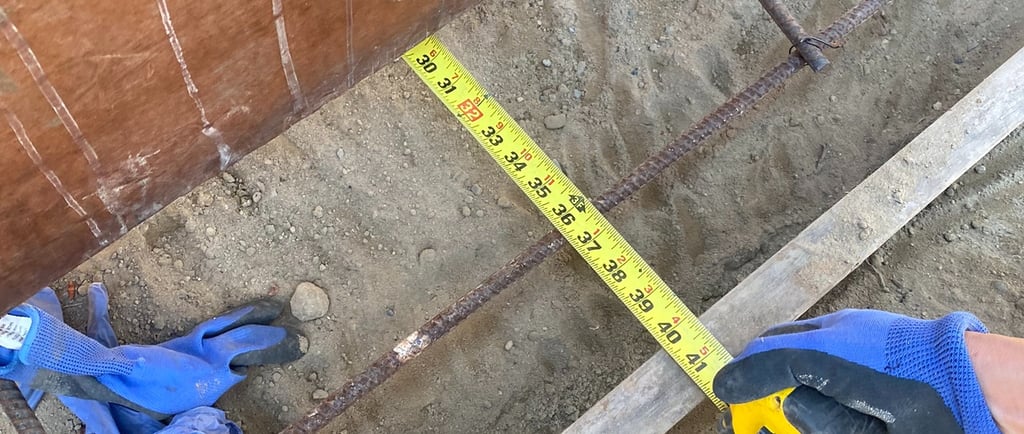
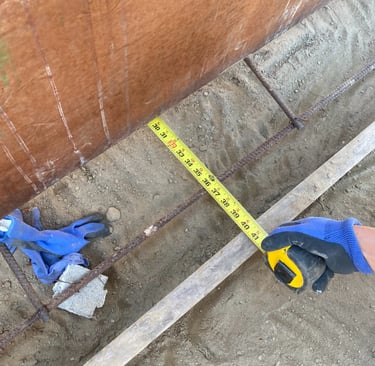
This project came to us as an after-the-fact retaining wall review. Five-foot retained height. No original stamped design. The city wanted an engineering evaluation.
At first glance, the “as-built” drawing didn’t inspire confidence.
The footing geometry shown would not have comfortably supported a 5-foot retained height under typical clay assumptions. The heel looked minimal. Under conservative soil parameters, sliding was borderline. If those dimensions were accurate, we were likely heading toward anchors or structural modification.
Before jumping to conclusions, we did what engineers are supposed to do — verify assumptions.
We reviewed owner-provided photos and field measurements carefully. The footing geometry in the field didn’t match the initial submittal. The actual base width was 3'-4" with a 1'-8" heel. That’s a meaningful difference. That extra heel length materially increases the stabilizing mass and friction resistance.
Geometry matters.
But geometry alone doesn’t solve a retaining wall.
The real turning point wasn’t the footing. It was the soil.
The geotechnical evaluation identified the site as very dense glacial till. That’s not generic fill. That’s not soft clay. That’s dense, high-friction material deposited by glacial action. From an engineering standpoint, that changes the math significantly.
Using the geotech parameters:
Friction angle of 30 degrees
Unit weight of 135 pcf
Allowable bearing capacity of 4,000 psf
Now we’re working with real site-specific data instead of conservative placeholders.
Even assuming no passive resistance at the toe — meaning we didn’t rely on soil in front of the footing — the base friction alone produced a sliding factor of safety of 1.7 under service loads. Code requires 1.5. That margin matters.
Overturning and bearing were also within acceptable limits.
The wall wasn’t “saved” by guesswork. It was validated by correct inputs.
This is the part most people miss.
Retaining walls are not just concrete geometry problems. They are soil-structure interaction problems. If you assume weak soil when the site actually has dense glacial till, you will overdesign. If you assume strong soil when it’s not there, you create risk.
Engineering is about replacing assumptions with verified parameters.
From a business standpoint, this case avoided unnecessary retrofits. Without verifying the soil and geometry, the default response might have been: widen the footing, add deadman anchors, or reconstruct portions of the wall. That would have cost real money.
Instead, we defined:
The exact geometry relied upon
The specific soil parameters used
The maximum surcharge allowed (60 psf)
The requirement that no soil be removed at the toe
The assumption of proper drainage
The letter did two things:
It confirmed the wall meets IBC 2021 stability requirements under defined conditions.
It clearly outlined the boundaries of that determination.
That’s what a proper engineer letter should do.
Not a rubber stamp.
Not fear-based overcorrection.
Not blind approval.
Just disciplined analysis, clear assumptions, and defined limits.
If you’re evaluating an existing retaining wall, the lesson is simple:
Don’t guess.
Don’t rely on sketches alone.
Don’t ignore the geotechnical report.
Soil is often the difference between failure and stability.
And sometimes, it’s the difference between a costly retrofit and a clean approval.